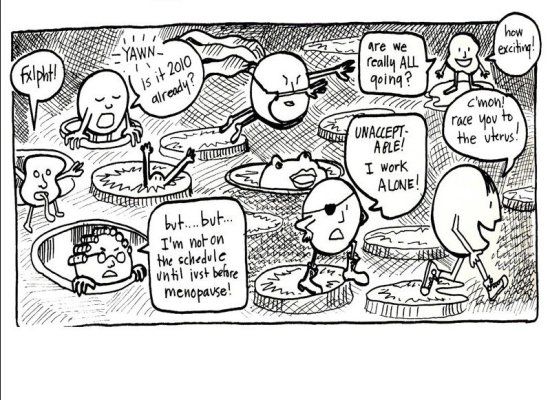
You might recall from my last infertility post that the genetic counselor decided to test me for Fragile X as a last attempt to explain my ovarian failure. Since my family has no history of Fragile X, any type of Mental Retardation or even Autism, I didn't think much about it. As it turns out, this was a bad move on my part.
As I hung up from a very successful conference call for work, my cell rang again in my hand. I didn't recognize the number, but since I'd been talking to three different states, I assumed it was work related and picked up without much thought. Instead of my web developer, it was the genetic counselor from Kaiser. In a voice too cheerful for the subject matter, she gently explained that my results came back positive for a Fragile X premutation. Normal people have between 0 and 54 trinucleotide repeats in their FMR1 gene on their X chromosomes, although some argue that there's another intermediate category between 45-54 repeats. Both of these repeat categories are stable, if mom or dad has 30 repeats, their kids will get 30 repeats and the allele will remain stable. There might be the tiniest bit of growth in the 45-54 region, if mom has 47 her child might have 50, but the again it's fairly stable.
People with Fragile X have over 200 CCG repeats, leaving a murky grey area in between for carriers with a premutation, 55-200. My test came back with 99 CGG trinucleotide repeats, putting me squarely into the group of carriers. The problem with this category is that the larger the repeat size, the more unstable it becomes. Although my other X chromosome is normal, a repeat of 99 on my bad X has, on the lower end, an 80% chance of expanding to a full mutation if passed on. This means that if my child received my faulty X, they would likely have full blown Fragile X. This is absolutely devastating news.
In addition to the crushing fear that my child might inherit severe mental retardation, we finally have an explanation for my failing ovaries. About 20% of women with a Fragile X premutation have premature ovarian failure, FXPOF or FXPOI. Women with more than 80 repeats are supposed to be at a lower risk for POF than those with smaller repeat sizes, but apparently my body didn't get the memo. This means that all the lovely symptoms I've been complaining about for years, hello hot flashes, night sweats, and weight gain, were because my ovaries were shutting down and my hormones were tanking as they tend to do when you go through menopause. Apparently my ovaries may continue to shut off, or spaztically turn back on every so often if they feel like it and only 5-10% of women with FXPOF can have children. Thus far I still appear to be making eggs every month so we're crossing our fingers that all hope is not lost yet. As you might be able to tell, I don't feel particularly hopeful.
In addition, I have to watch out for FXTAS. Although it tends to be a bigger problem for men with only one X chromosome, rather than women who have some protection from their good chromosome, FXTAS causes ataxia, tremors, memory loss, dementia, a loss of feeling and weakness in the lower legs, and even mental and behavioral changes. Basically, another horrific possibility, even if it usually effects men.
If you've been following along thus far, let's take a look at our odds.
Me:
0.44% or 1 in 225 women have a Fragile X Premutation
20% of women with a premutation have POF, or 20% of 0.44% which is 0.088%
E:
0.033% - 0.05% of men have y chromosome infertility
10% of Y chromosome infertility involves a deletion in the b region, so 0.0033% - 0.005%
Can you imagine the odds of both of us having such catastrophic genetic infertility?
Seriously, what in the ever loving fuck universe.
What. The. Fuck.